I reflect now on my brothers and sisters in Christ. I thought, "I bet Heavenly Father deals with this too." Sometimes if I see an issue with a "brother or sister," I can bring it to their attention, but the correction is not necessarily mine to handle. I need to make sure my rebuke isn't so hefty that they are distracted from the Voice of correction they really need to hear. I can intercede on their behalf to Father, even tattle to Him, but if I am obedient I will likely do more praying for them than yelling at them.
Monday, June 3, 2013
Thought for the day June 3, 2013
I just experienced a moment with my kids arguing. I tried to single one out to discuss the issue and correct it, but the other consistently yelled at the other telling them how wrong they were. this condemning was so loud that it was not easy to hear my voice and correction. We dealt with the whole thing.


Wednesday, April 10, 2013
Basic Bible Study - Conclusion
Previous Lessons
Part 1 - Parts of the Bible Part 2 - Bible Translations, Paraphrases and Reading Plans Part 3 - Bible Footnotes and Maps Part 4 - Digital Bible Study Part 5 -Journals Part 6 - Highlighting and Noticing Patterns Part 7 - Application using 5 W's Part 8 - Application of the Bible Part 9 - Topical Bible Study Part 10 - Basic Word Study
Part 11 - Wrapping it up
Hopefully all who have read these lessons or studied live with us have been able to glean at least something from our lessons. We started by learning the very basics and went through to learning how to do a word study by going to the original language of the Bible. This study only scratched the surface of the ways one can study the Bible.
Another method that we discussed briefly in class is the S.O.A.P. method of study. Start with SCRIPTURE where you write down that scripture. Then comes OBSERVATION where you take note of the observations you've made about the scripture. Next is APPLICATION where you discover how to apply the scripture. Last is PRAYER where you ask for God's help to apply the scripture to your daily life.
The main objective that I would have for you is that you begin to at least read the Word of God for yourself. Starting this is key. I hope now you feel you have a place to start.
All of the lessons in this study go hand in hand with each other. Maybe you'll use lesson 6 and 8 togehter. Maybe you will use 3 and 6 and 9 in the same study. There are many combinations and many methods. There are also some resources that we talked about in our classroom that haven't been on the blog. One of those is The Bare Bones Bible Handbook by Jim George. There is also Halley's Bible Handbook. There are so many Study Bibles available as well with great commentary. Some of them are interest-based like the Worship, Spirit Filled Life, Life Application, Student, Archaeological, and version-based Study Bibles. Those just name a few.
I end with a list of tools you can use to study the Word of God on your own. Please do not forget that we need each other as well. Hebrews 10:23-25 NLT "Let us hold tightly without wavering to the hope we affirm, for God can be trusted to keep his promise. Let us think of ways to motivate one another to acts of love and good works. And let us not neglect our meeting together, as some people do, but encourage one another, especially now that the day of his return is drawing near."
Part 1 - Parts of the Bible Part 2 - Bible Translations, Paraphrases and Reading Plans Part 3 - Bible Footnotes and Maps Part 4 - Digital Bible Study Part 5 -Journals Part 6 - Highlighting and Noticing Patterns Part 7 - Application using 5 W's Part 8 - Application of the Bible Part 9 - Topical Bible Study Part 10 - Basic Word Study
Part 11 - Wrapping it up
Hopefully all who have read these lessons or studied live with us have been able to glean at least something from our lessons. We started by learning the very basics and went through to learning how to do a word study by going to the original language of the Bible. This study only scratched the surface of the ways one can study the Bible.
Another method that we discussed briefly in class is the S.O.A.P. method of study. Start with SCRIPTURE where you write down that scripture. Then comes OBSERVATION where you take note of the observations you've made about the scripture. Next is APPLICATION where you discover how to apply the scripture. Last is PRAYER where you ask for God's help to apply the scripture to your daily life.
The main objective that I would have for you is that you begin to at least read the Word of God for yourself. Starting this is key. I hope now you feel you have a place to start.
All of the lessons in this study go hand in hand with each other. Maybe you'll use lesson 6 and 8 togehter. Maybe you will use 3 and 6 and 9 in the same study. There are many combinations and many methods. There are also some resources that we talked about in our classroom that haven't been on the blog. One of those is The Bare Bones Bible Handbook by Jim George. There is also Halley's Bible Handbook. There are so many Study Bibles available as well with great commentary. Some of them are interest-based like the Worship, Spirit Filled Life, Life Application, Student, Archaeological, and version-based Study Bibles. Those just name a few.
I end with a list of tools you can use to study the Word of God on your own. Please do not forget that we need each other as well. Hebrews 10:23-25 NLT "Let us hold tightly without wavering to the hope we affirm, for God can be trusted to keep his promise. Let us think of ways to motivate one another to acts of love and good works. And let us not neglect our meeting together, as some people do, but encourage one another, especially now that the day of his return is drawing near."
·
Table of Contents
·
Footnotes
·
Cross-References
·
Maps
·
YouVersion
·
E-sword
·
Other Digital Bibles
·
Journal
·
Bible Study Helps books/Handbooks
·
Highlighters
·
Noticing Patterns
·
Symbols with different personal meanings
·
5 W’s
·
Application Worksheets
·
Strong’s Concordance
·
1828 Webster’s Dictionary or other reliable
dictionary
·
Thesaurus
·
Topical Bible
·
Study Bible
·
In-Bible Concordance
·
In-Bible Index or dictionary or other reference
·
Parallel Studies
·
Context – before and after the verse
·
Chapter introductions
·
S.O.A.P study
Wednesday, April 3, 2013
Basic Bible Study - Part 10
Previous Lessons
Part 1 Part 2 Part 3 Part 4 Part 5 Part 6 Part 7 Part 8 Part 9
Part 1 Part 2 Part 3 Part 4 Part 5 Part 6 Part 7 Part 8 Part 9
Lesson 10.0 Basic Word Study
This week we will learn a very basic form of word study. A word study is when you find a word from the
Bible and look it up in its original Hebrew or Greek.
Let’s first review a few points. The Old Testament was originally written in
Hebrew/Aramaic and the New Testament was written in Greek. There have been many translators who’ve
translated the Bible into English as well as other languages and none of the
translations are “purer” than others because the word “love,” for example,
encompasses several different original Bible words so sometimes we need to know
the Bible word that was originally written to mean love if we want a better
understanding of the text.
We don’t have to rely on scholars or teachers to give us
this information, the tools are available to us at the library and at church
and at the bookstore. We just need to
know what to look for. There is
something called a Greek Lexicon or a Hebrew Lexicon and they are valuable
tools; however, for the average Bible student they go very deep and you have to
understand the Greek or Hebrew alphabets to be able to use them. If you’d like more information on these,
you’ll have to seek out that information and it is out there, but it will be a
significant investment of your time.
One of the simplest ways to do a word study is with a King
James Bible and Strong’s Concordance.
The Strong’s concordance was made specifically to give definition to
every word used in the King James translation.
You will notice that the word, “cometh,” is not in the NIV. There are concordances written for other
translations as well, but the Strong’s has been proven and used for many
years. Another tool that is good to use
with the Strong’s Concordance is a Webster’s Dictionary that was published in
1828. Why that year? That was the year that the King James Bible
was first written, so in order to understand the definitions of the period, we
need a dictionary of that period. One of
the words in the KJV is “thong.” Today’s
definition is not the same as the previous.
John was saying that he wasn’t worthy of untying Jesus’ sandals … it had
nothing to do with undergarments. While
that example may be humorous, there are others that could make our
understanding of His Word a little skewed.
The first step in doing a word study is finding the word
you’d like to search out.
Let’s start with just one verse. Isaiah 55:6 KJV “Seek ye the Lord while he may be found, call
ye upon him while he is near.”
If we open the
concordance to MAIN CONCORDANCE, there are headers on the left upper corner of
the left page and right upper corner of the right page just like a
dictionary.
We will start with SEEK as it is the first word in the
passage.
Once we find the word SEEK in the Main Concordance section
we will look for “Isa 55:6” to give us the Strong’s number for the word,
SEEK. Some English words have multiple
Hebrew words that could mean the same thing.
In Isaiah 55:6, SEEK is given the Strong’s number “1875.” Notice that this number is in standard type
and some other numbers are in italics. Standard
type is Hebrew and italics are Greek words.
We are not at the end of this search. Now we need to go to the next section of
Strong’s that is the HEBREW AND CHALDEE DICTIONARY and find number 1875. You will find a similar entry to this:
דּרשׁ
dârash, daw-rash'; A primitive root; properly to tread
or frequent; usually to follow (for pursuit or search); by
implication to seek or ask; specifically to worship: - ask,
X at all, care for, X diligently, inquire, make inquisition, [necro-] mancer,
question, require, search, seek [for, out], X surely.
This may be a bit confusing to look at, but we can gather
from this entry that the possible meanings of this word are to follow; by
implication to seek or ask; specifically to worship. The words that follow that are not in italics
are possible translations of the word in to English.
That is just the first word of the verse. Follow the same steps for the rest of the
words in the verse. Words like "ye," "with," and "the" are actually found between the Main Concordance and the Hebrew and
Chaldee Dictionary in a section they refer to as Appendix as they are quite
frequently used. Also remember that some
phrases in English are only one word in other languages and vice versa. The only way to find out the exact original
text is to use the original text and go back to English. This is an imperfect way of word study, but it
is effective for the basic scholar.
These instructions do sound complicated, but once you’ve
looked up a few words, you’ll begin to get the hang of it. If you recall, we discussed e-Sword in a
previous lesson. If you look at the
translation KJV+, the program has done the footwork for you. Instead of using standard lettering and
italics, they use numbers like H1875 and G111.
If you hover over the number, the Hebrew and Chaldee Dictionary or the
Greek Dictionary of the New Testament entry will appear in a pop-up box. This method saves a lot of time, but not
every word of every verse has a number associated with it.
Then we can also look up the words in the Webster’s 1828
Dictionary. Here is the entry for Seek
as copied from e-Sword:
Seek
SEEK, v.t. pret
and pp. sought, pronounced sawt. [L. sequor, to
follow; for to seek is to go after, and the primary sense is to advance,
to press, to drive forward, as in the L. peto.]
1. To go in searh or quest of;
to look for; to search for by going from place to place.
The man asked him, saying, what
seekest thou? And he said, I seek my brethen.
Gen 37.
2. To inquire for; to ask for;
to solicit; to endeavor to find or gain by any means.
The young lions roar after
their prey, and seek their meat from God. Psa 104.
He found no place for
repentance, though he sought it carefully with tears. Heb 12
Others tempting him, sought of him a sign. Luke
11.
3.Seek is followed
sometimes by out or after. To seek out, properly
implies to look for a specific thing among a number. But in general, the use of
out and after with seek, is unnecessary and inelegant.
To seek God,
his name, or his face, in Scripture, to ask for his favor, direction and
assistance. Psa 83.
God seeks
men, when he fixes his love on them, and by his word and Spirit, and the
righteousness of Christ, reclaims and recovers them from their miserable
condition as sinners.
Ezek 34. Psa 119. Luke 15.
To seek
after the life, or soul, to attempt by arts or machinations; or to attempt to
destroy or ruin. Psa 35.
To seek
peace, or judgement, to endeavor to promote it; or to practice it.
Psa 34. Isa 1.
To seek an
altar, temple, or habitation, to frequent it; to restore to
it often.
2 Chr 1. Amos 5.
To seek out God's works, to endeavor to understand them. Psa 111.
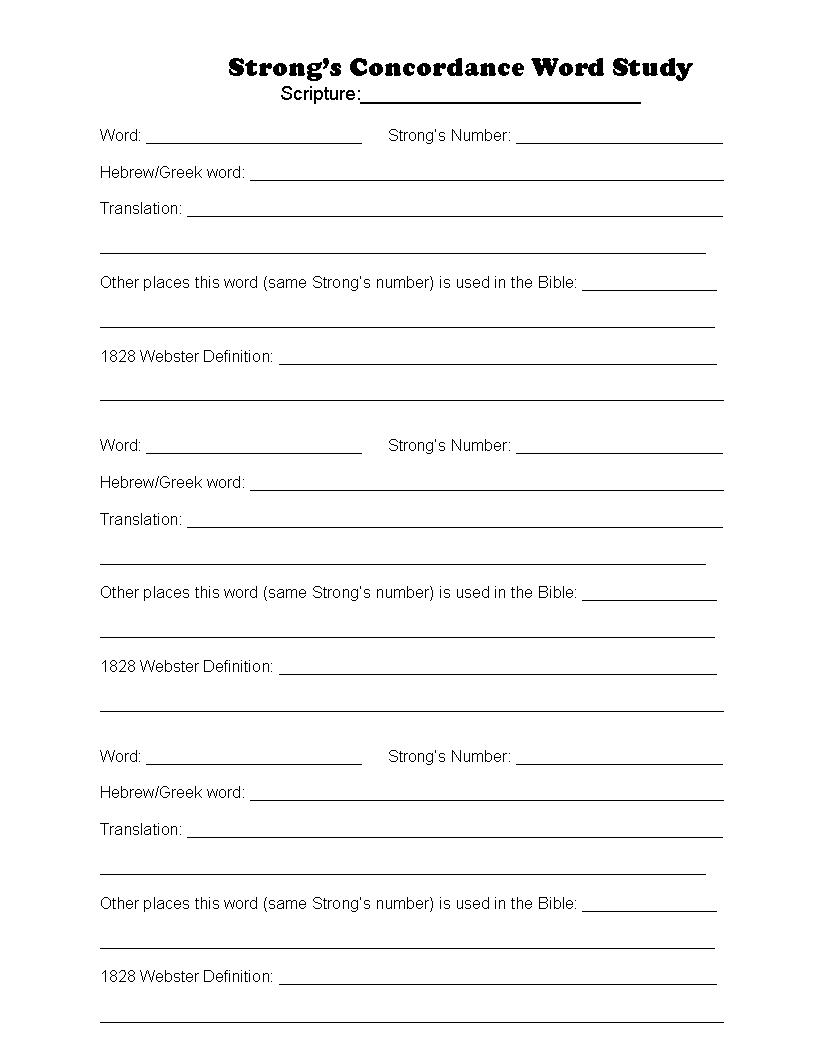 |
| Here is a worksheet to help you get started |
LESSON 10.0 Worksheet
What translation of the Bible do you need to use with the
Strong’s Concordance?
Are there other reliable concordances available?
Why should we use the 1828 Webster’s Dictionary when
studying with the Strong’s Concordance and King James Version of the Bible?
HOMEWORK
If you have e-sword or a Strong’s Concordance and King James
Version Bible, look up one of your favorite verses and see if your
understanding of that verse changes or stays the same after searching the words
in it.
Look up the word “loved” from John 3:16. What is the Greek word used?
Is that your understanding of how God loved the world?
Wednesday, March 27, 2013
Basic Bible Study - Part 9
Previous lessons
Lesson 9.0 Topical Bible Study
Here is where I am going to veer off my original plan and switch lessons 9 and 10 around. We will learn about topical Bible study today and next week about basic word studies. Word study is one of the more complicated subjects, but topical studies can be a stepping stone into word studies.
Most Bibles have a concordance of their own. We will use the larger Strong’s Concordance next week, but this week we will be using the concordance that we carry with us in our own Bibles. If you look at the back of your Bible, you might find a concordance. It often is limited in its content. There are several advantages to this type of concordance. First of all, it is attached to your Bible, so you don’t need a table full of books to use it. I like to use mine in bed as I read at night. Second, it has the same wording that your Bible has so you don’t have to find make sure your Bible and Concordance match translations. Third, if it is the Bible you are use to using, you can become familiar with it quickly. Finally, it is concise so you don’t have to wade through a bunch of entries to find what you’re looking for.
On the flip side while the back of your Bible’s concordance is concise, you may not find the verse you’re looking for. The Hebrew or Greek word or definition is not often available in these concordances.
A concordance is not a dictionary, but more like the key is to a map. Not every word in a Bible will be in a concordance. For instance“articles” are not in there, so you won’t find every – and, the, a. Looking at the verse, John 3:16, “For God so loved the world that he gave his only begotten son that whosoever believeth in Him should not perish but have everlasting life.” You would likely find the words, “God, loved, world, gave, begotten, son, whosoever, believeth, him, perish, everlasting, life.” These would be key words to look for in the concordance.
Why is do we need these? One reason could be to find the verse. If you remember the verse but not the reference, you can use one of those words to find where it is located in the Bible. I would liken it to an internet search engine. If I wanted to find out how to make chocolate milk, I could find it with the word “chocolate”or “milk.” In the concordance, rather than giving me website options, I get scripture options. If I look up “world,” in the back of one Bible, I get 14 different options including John 3:16, John 7:7 and Titus 2:12, but before each scripture reference, is a phrase from the verse it represents. “God so loved the w…” is the phrase before John 3:16. I can then turn to that scripture and see if it is what I was looking for. Another entry says, “Don’t copy… this w…”Rom 12:2. The “w” represents the word I looked up “world.” That particular Bible gave a definition to the word as well. Not every Bible Concordance will do that.
 |
| Here is an sample of the concordance entry from the NIV Study Bible for the word, "world." |
The lesson today is about topical Bible study and it took me a bit to get there, but that you have a bigger understanding of the concordance use, we can discuss how it can be a valuable tool in topical study. My kids and I did a month of lessons on “Trust.” That is a big topic, so the curriculum writer has narrowed the areas down so at one point we learned about sheep. Sheep trust their shepherd. The Bible refers to sheep a lot and Jesus refers to us a sheep and God being the shepherd. I want to know more about this. While the people of Jesus' time and area of the world could relate to sheep, I cannot fully grasp the inferences. I've worn wool and seen sheep in real life,but know nothing about their habits, so I did a topical study on them. I went to my concordance for a good starting place. I looked up, "sheep," and I looked up, "Shepherd." Once I found a few verses about them, there was another word that was commonly used, "Flock." It became another word I looked up. Other words that were used in my search were: Sheepfold, wool, lamb and staff. You can make a topical study quick or as lengthy as you want. It's your study and either way you will learn.
I can also look up things like anger or sadness or joy or fishing. If the Lord lays a word on your heart, check it out in The Word. My language may not make sense to you, but if there is a word you hear in conversation or one just pops in your mind, especially in prayer, it may be something to look up. I had the word “ubiquitous” randomly pop into my head. I didn't even know what it meant. The first place I went was not the concordance, it was a dictionary and since I like electronic devices, I actually used dictionary.com on my phone. Instant gratification… it means the same as omnipresent. Everywhere. At that point, I found another search I could do in the Bible. It didn't take long… neither word is in the Bible according to the few translations I used. Though I heard the word omnipresent as I was growing up in Sunday School, it was strange for me to find that it was not actually in the Bible. The Bible does describe in several places, however, that God is everywhere.
There are a few other books that are useful for topical studies. Some are devotional books and some are encouraging mini books. There are topical Bibles as well. There are many emails going around with multiple scriptures on a subject too. A way to make these things into a study can be to look up the verse about a topic and then go back and look at the verses surrounding it as we've done before to get the context. Then you can go to footnotes and cross-references and ... you get the idea.
One book that I have that is topical was given to me as I graduated from High School. It is called, "God's Promises for the Graduate," published by Thomas Nelson Publishers. There are headings in the table of contents that lead to pages of scriptures related to that topic. One such topic in that book, for example, is "For in Times of Anger." There are 21 scriptures that are quoted in that section. One of them is Ephesians 4:31-32 NKJV "Let all bitterness, wrath, anger, clamor and evil speaking be put away from you, with all malice. And be kind to one another, tenderhearted, forgiving one another, just as God in Christ also forgave you." If I need to know more of what the Bible says about anger (likely I do) I can look up all of those scriptures in context and make a great study out of them.
LESSON 9.0 Worksheet
When would you use the concordance in your Bible?
Do concordances in the back of most Bibles give every scripture reference for each entry?
Does every back of Bible concordance also include definitions for the words?
Are dictionaries useful for topical studies?
Homework:
Is there a topic that is dear to you that you've been curious about? Don’t wait for Joel Osteen or some great preacher/teacher to write a book about it. Look up the key word(s) and search out the Word of God concerning that topic over the next few weeks.
Wednesday, March 20, 2013
Basic Bible Study - Part 8
Previous Lessons
LESSON 8.0 Application of the Word.
It is amazing to me to see how something recorded so many years ago can
still apply to me today. Some scriptures
are plain: Acts 2:38 “Repent and be baptized…” while others may be a little confusing. Mark 10:21 “Go and sell everything you have
...” There is more to each of these
phrases and that is when we need to focus on learning to apply the word. Often times, when you do a devotional or even look on
Facebook, there is a scripture just pulled out.
One stand alone verse. While this
is appropriate in its intent, if you want to know the full meaning of each
verse, you need to go deeper.
Let’s start with one verse and see how we can put
application to it.
I John 1:9 NIV “If we confess our sins, He is faithful and just and will forgive us our sins and to purify us from all unrighteousness.”
This verse can definitely stand alone or be used with other
scriptures especially when beginning or leading someone into a relationship with Christ. Let’s take a closer look and apply it. Let’s read it in context. That means read what comes before it and what
comes after it. Open your Bible to I
John 1:9. What is a good place to
start? What is a good place to end? Letting the Bible interpret itself is a
wonderful way to study it. Some may look at our Bible's subheadings as my NIV Life Application Bible shows a subheading just before I John 1:5 that says, "Walking in the Light." Others may wish to go to the beginning of the chapter. If you don't understand a verse by reading the verse or two before it, go back further. This may mean to go to the beginning of a book or a chapter. My life Application Bible continues a section from I John 1:5 to I John 2:14. This may all be necessary to read to understand the true intent of that single verse.
Let’s look at a few other places in the Bible and use 2
different application worksheets. The
first one is called “Application Worksheet.” This and the other worksheets in this lesson are adapted from “Inductive Bible Study Handbook from Leadership Resources
International. I have looked into trying
to order more of this book, but it has no ISBN and I can’t find them
online. The front cover said to
photocopy and put to use. While I do not understand if there would be a copyright infringement by using those sheets on a blog, I have recreated them and really they do look a lot different, the ideas are just the same. This first one is not intended to be completely filled
out because not every passage covers everything on this worksheet.

Look at Matthew 6: 19-34 and use it with this sheet. This passage is loaded so we can fill out
several sections of the worksheet. You also may have more than one answer for each question. Is there a lesson to learn? Where your treasure is, there your heart will be also. Is there a prayer to pray? I don't see a specific prayer to pray her, but if I look at Matthew 6:9-13, I would find a whole prayer. Is there a sin to confess? This is personal. If there is an instruction in this passage that I struggle with as sin, I would likely write it here. Is there a promise to claim? Seek first his kingdom and his righteousness, and all these things will be given to you as well. Is there a message to share? There are several messages in this text. This is a place where you need to have the guidance of the Holy Spirit. Some of these messages need to be shared, but if you do so in your own power, you could turn people away. If I go to my wealthy Christian friend and say, "You can't serve both God and money!" I don't think it would be well received. That is likely me judging my friend saying that they worship their money. Is there an instruction to obey? This is similar to the first question. Do not worry about your life. (One of several answers that can go here) Is there a conflict to avoid? Again, this is a personal application so if you struggle with money, maybe that is a conflict you need to avoid. Is there an example to follow? One could say that we should follow the example of the sparrow and don't worry about what you will eat. Is there a new understanding to embrace? There could be if you've never really noticed any of these teachings before. Is there an attribute of God to marvel? My heavenly Father knows my needs. Each person who fills out this sheet will fill it out differently from others. You really don't even need this sheet, you can just keep these thoughts in mind as you read new scripture. You can answer some of these questions in your journal as well.
The next worksheet we will look at is a character
worksheet. It is possibly a little more thought
provoking . Here is one reason
that this type of worksheet would be good.
If you’ve ever been told something like, “You have
the heart of David.” or, "You have an Esther anointing." It is important to review the Word
and find out exactly what David or Esther did. David is spoken of over a long portion of the Bible and though Esther is a small book, we’ll use
something that is fresh in our memory from a recent study.
Let’s look at the Character Jonah. Last week we looked at the book about him, this week, let’s look at some character things. We will find out about him in his book, Jonah.

Jonah is mentioned in the Bible in the Old Testament book of Jonah. He is also mentioned in Matthew 12:37,39,40,41; Matthwe 16:4,17; Luke 11:28,30,32 and II Kings 14:25. I found this by doing a search on my digital Bible e-Sword. When I searched on YouVersion, it misinterpreted my search and looked for John as well.
Always remember that when we use a new method of study or a
new worksheet that we still have all of the other things we’ve talked about to
go back to as well: footnotes, commentaries, cross-references, 5 W’s and
patterns.
Here are 2 other possible worksheets to use. They will be used in the homework section.


Lesson 8.0
Each new lesson adds to the previous. Now that we are learning to apply the Bible,
we can use the previous lessons to help.
Name 2 of these things:
In your own words, describe why it would be valuable to you
to study a certain character of the Bible.
This answer doesn’t have to be the one given in class.
Homework
Use “Personal Application Worksheet” to look at Matthew 6:19-34
again. Use “Parable Study Worksheet” to look at the Parable of the Good Samaritan from Luke 10:30-37.
Subscribe to:
Posts (Atom)