Showing posts with label Bible Study. Show all posts

Thursday, April 9, 2015

Drawing Near

"Draw near to God and He will draw near to you."
That has been on my heart this week and I can't shake it.  I actually had it as though it said, "Draw near to Me and I will draw near to you."  Jesus didn't say that exact line.  While he could have said that, it is not recorded in the gospels.  This is a portion of scripture in James 4:8.  It is not even the whole verse nor even the whole context.  Yes, it can stand alone; however, it has more fullness when looking at the whole context.  I'm always amazed when what I thought I knew is only a portion of the fullness of what I can know.

James 4:1-10 NIV  What causes fights and quarrels among you? Don’t they come from your desires that battle within you? You desire but do not have, so you kill. You covet but you cannot get what you want, so you quarrel and fight. You do not have because you do not ask God. When you ask, you do not receive, because you ask with wrong motives, that you may spend what you get on your pleasures.
You adulterous people, don’t you know that friendship with the world means enmity against God? Therefore, anyone who chooses to be a friend of the world becomes an enemy of God. Or do you think Scripture says without reason that he jealously longs for the spirit he has caused to dwell in us? But he gives us more grace. That is why Scripture says:
    “God opposes the proud
    but shows favor to the humble.”
Submit yourselves, then, to God. Resist the devil, and he will flee from you. Come near to God and he will come near to you. Wash your hands, you sinners, and purify your hearts, you double-minded. Grieve, mourn and wail. Change your laughter to mourning and your joy to gloom. 10 Humble yourselves before the Lord, and he will lift you up.
11 Brothers and sisters, do not slander one another. Anyone who speaks against a brother or sister or judges them speaks against the law and judges it. When you judge the law, you are not keeping it, but sitting in judgment on it. 12 There is only one Lawgiver and Judge, the one who is able to save and destroy. But you—who are you to judge your neighbor?
I am not a deep theologian, but from this text it appears that James is speaking to a group of people who are not getting along.  James is writing to them and giving them truth and some pointers to overcome these issues.  There are battles within them.  They ask for things with wrong motives.  They are not humble.  He says in verse 7 to submit to God and resist the devil.  Come near to God and He WILL come near to you (verse 8).  Purify your hearts.  Humble yourselves before the Lord and He will lift you up (verse 10).  Don't talk about each other.  I believe that out of the overflow of the love you have for Christ, these things will come. 
Holiness isn't something to just sign up for and BOOM you got it.  It is something to work at.  Righteousness is something that comes through seeking the Lord and finding Him.  There are struggles.  There will be struggles.  Jesus was even tempted, and by the Word of God, He overcame.  He desires a relationship with us and in light of that relationship, our desires will be drawn toward Him and no other.
I'm doing studies on the Gospel of John and the epistle of I John in my church right now and it seems like there's a theme in the message Jesus gives to His disciples right before His crucifixion in John 13-16 as well as the message in I John.  I leave you with a few of these scriptures as well as portions of Isaiah 55.  May there be for you Shalom, His peace.
John 13:34-35 34 “A new command I give you: Love one another. As I have loved you, so you must love one another. 35 By this everyone will know that you are my disciples, if you love one another.”
John 14:12-14  12 Very truly I tell you, whoever believes in me will do the works I have been doing, and they will do even greater things than these, because I am going to the Father. 13 And I will do whatever you ask in my name, so that the Father may be glorified in the Son. 14 You may ask me for anything in my name, and I will do it.
John 15:5  “I am the vine; you are the branches. If you remain in me and I in you, you will bear much fruit; apart from me you can do nothing.
John 15:9-12 “As the Father has loved me, so have I loved you. Now remain in my love. 10 If you keep my commands, you will remain in my love, just as I have kept my Father’s commands and remain in his love. 11 I have told you this so that my joy may be in you and that your joy may be complete. 12 My command is this: Love each other as I have loved you.
I John 2:9-11 Anyone who claims to be in the light but hates a brother or sister is still in the darkness. 10 Anyone who loves their brother and sister lives in the light, and there is nothing in them to make them stumble. 11 But anyone who hates a brother or sister is in the darkness and walks around in the darkness. They do not know where they are going, because the darkness has blinded them.
I John 4:7-12 Dear friends, let us love one another, for love comes from God. Everyone who loves has been born of God and knows God. Whoever does not love does not know God, because God is love. This is how God showed his love among us: He sent his one and only Son into the world that we might live through him. 10 This is love: not that we loved God, but that he loved us and sent his Son as an atoning sacrifice for our sins. 11 Dear friends, since God so loved us, we also ought to love one another. 12 No one has ever seen God; but if we love one another, God lives in us and his love is made complete in us.
Isaiah 55:1,6-9 
“Come, all you who are thirsty,
    come to the waters;
and you who have no money,
    come, buy and eat!
Come, buy wine and milk
    without money and without cost.
Seek the Lord while he may be found;
    call on him while he is near.
Let the wicked forsake their ways
    and the unrighteous their thoughts.
Let them turn to the Lord, and he will have mercy on them,
    and to our God, for he will freely pardon.
“For my thoughts are not your thoughts,
    neither are your ways my ways,”
    declares the Lord.
“As the heavens are higher than the earth,
    so are my ways higher than your ways
    and my thoughts than your thoughts.
 

Wednesday, April 10, 2013

Basic Bible Study - Conclusion

Previous Lessons
Part 1 - Parts of the Bible Part 2 - Bible Translations, Paraphrases and Reading Plans Part 3 - Bible Footnotes and Maps Part 4 - Digital Bible Study Part 5 -Journals Part 6 - Highlighting and Noticing Patterns Part 7 - Application using 5 W's Part 8 - Application of the Bible Part 9 - Topical Bible Study Part 10 - Basic Word Study

Part 11 - Wrapping it up

Hopefully all who have read these lessons or studied live with us have been able to glean at least something from our lessons.  We started by learning the very basics and went through to learning how to do a word study by going to the original language of the Bible.  This study only scratched the surface of the ways one can study the Bible.

Another method that we discussed briefly in class is the S.O.A.P. method of study.  Start with SCRIPTURE where you write down that scripture.  Then comes OBSERVATION where you take note of the observations you've made about the scripture.  Next is APPLICATION where you discover how to apply the scripture.  Last is PRAYER where you ask for God's help to apply the scripture to your daily life.
The main objective that I would have for you is that you begin to at least read the Word of God for yourself. Starting this is key.  I hope now you feel you have a place to start.

All of the lessons in this study go hand in hand with each other.  Maybe you'll use lesson 6 and 8 togehter.  Maybe you will use 3 and 6 and 9 in the same study.  There are many combinations and many methods.  There are also some resources that we talked about in our classroom that haven't been on the blog.  One of those is The Bare Bones Bible Handbook by Jim George.  There is also Halley's Bible Handbook.  There are so many Study Bibles available as well with great commentary.  Some of them are interest-based like the Worship, Spirit Filled Life, Life Application, Student, Archaeological, and version-based Study Bibles.  Those just name a few.

I end with a list of tools you can use to study the Word of God on your own.  Please do not forget that we need each other as well.  Hebrews 10:23-25 NLT "Let us hold tightly without wavering to the hope we affirm, for God can be trusted to keep his promise.  Let us think of ways to motivate one another to acts of love and good works.  And let us not neglect our meeting together, as some people do, but encourage one another, especially now that the day of his return is drawing near."

·         Table of Contents
·         Footnotes
·         Cross-References
·         Maps
·         YouVersion
·         E-sword
·         Other Digital Bibles
·         Journal
·         Bible Study Helps books/Handbooks
·         Highlighters
·         Noticing Patterns
·         Symbols with different personal meanings
·         5 W’s
·         Application Worksheets
·         Strong’s Concordance
·         1828 Webster’s Dictionary or other reliable dictionary
·         Thesaurus
·         Topical Bible
·         Study Bible
·         In-Bible Concordance
·         In-Bible Index or dictionary or other reference
·         Parallel Studies
·         Context – before and after the verse
·         Chapter introductions
·         S.O.A.P study

Wednesday, April 3, 2013

Basic Bible Study - Part 10

Previous Lessons
Part 1  Part 2  Part 3  Part 4  Part 5  Part 6  Part 7  Part 8  Part 9


Lesson 10.0 Basic Word Study

This week we will learn a very basic form of word study.  A word study is when you find a word from the Bible and look it up in its original Hebrew or Greek.
 
Let’s first review a few points.  The Old Testament was originally written in Hebrew/Aramaic and the New Testament was written in Greek.  There have been many translators who’ve translated the Bible into English as well as other languages and none of the translations are “purer” than others because the word “love,” for example, encompasses several different original Bible words so sometimes we need to know the Bible word that was originally written to mean love if we want a better understanding of the text.

We don’t have to rely on scholars or teachers to give us this information, the tools are available to us at the library and at church and at the bookstore.  We just need to know what to look for.  There is something called a Greek Lexicon or a Hebrew Lexicon and they are valuable tools; however, for the average Bible student they go very deep and you have to understand the Greek or Hebrew alphabets to be able to use them.  If you’d like more information on these, you’ll have to seek out that information and it is out there, but it will be a significant investment of your time.

One of the simplest ways to do a word study is with a King James Bible and Strong’s Concordance.  The Strong’s concordance was made specifically to give definition to every word used in the King James translation.  You will notice that the word, “cometh,” is not in the NIV.  There are concordances written for other translations as well, but the Strong’s has been proven and used for many years.  Another tool that is good to use with the Strong’s Concordance is a Webster’s Dictionary that was published in 1828.  Why that year?  That was the year that the King James Bible was first written, so in order to understand the definitions of the period, we need a dictionary of that period.  One of the words in the KJV is “thong.”  Today’s definition is not the same as the previous.  John was saying that he wasn’t worthy of untying Jesus’ sandals … it had nothing to do with undergarments.  While that example may be humorous, there are others that could make our understanding of His Word a little skewed.

The first step in doing a word study is finding the word you’d like to search out. 

Let’s start with just one verse.  Isaiah 55:6 KJV  “Seek ye the Lord while he may be found, call ye upon him while he is near.”

If we open the concordance to MAIN CONCORDANCE, there are headers on the left upper corner of the left page and right upper corner of the right page just like a dictionary. 

We will start with SEEK as it is the first word in the passage. 

Once we find the word SEEK in the Main Concordance section we will look for “Isa 55:6” to give us the Strong’s number for the word, SEEK.  Some English words have multiple Hebrew words that could mean the same thing.  In Isaiah 55:6, SEEK is given the Strong’s number “1875.”  Notice that this number is in standard type and some other numbers are in italics.  Standard type is Hebrew and italics are Greek words.
We are not at the end of this search.  Now we need to go to the next section of Strong’s that is the HEBREW AND CHALDEE DICTIONARY and find number 1875.  You will find a similar entry to this:
דּרשׁ
dârash, daw-rash'; A primitive root; properly to tread or frequent; usually to follow (for pursuit or search); by implication to seek or ask; specifically to worship: - ask, X at all, care for, X diligently, inquire, make inquisition, [necro-] mancer, question, require, search, seek [for, out], X surely.

This may be a bit confusing to look at, but we can gather from this entry that the possible meanings of this word are to follow; by implication to seek or ask; specifically to worship.  The words that follow that are not in italics are possible translations of the word in to English.

That is just the first word of the verse.  Follow the same steps for the rest of the words in the verse.  Words like "ye," "with," and "the" are actually found between the Main Concordance and the Hebrew and Chaldee Dictionary in a section they refer to as Appendix as they are quite frequently used.  Also remember that some phrases in English are only one word in other languages and vice versa.  The only way to find out the exact original text is to use the original text and go back to English.  This is an imperfect way of word study, but it is effective for the basic scholar.

These instructions do sound complicated, but once you’ve looked up a few words, you’ll begin to get the hang of it.  If you recall, we discussed e-Sword in a previous lesson.  If you look at the translation KJV+, the program has done the footwork for you.  Instead of using standard lettering and italics, they use numbers like H1875 and G111.  If you hover over the number, the Hebrew and Chaldee Dictionary or the Greek Dictionary of the New Testament entry will appear in a pop-up box.  This method saves a lot of time, but not every word of every verse has a number associated with it.

Then we can also look up the words in the Webster’s 1828 Dictionary.  Here is the entry for Seek as copied from e-Sword:

Seek

SEEK, v.t. pret and pp. sought, pronounced sawt. [L. sequor, to follow; for to seek is to go after, and the primary sense is to advance, to press, to drive forward, as in the L.  peto.]

1. To go in searh or quest of; to look for; to search for by going from place to place.

The man asked him, saying, what seekest thou? And he said, I seek my brethen.

Gen 37.

2. To inquire for; to ask for; to solicit; to endeavor to find or gain by any means.

The young lions roar after their prey, and seek their meat from God. Psa 104.

He found no place for repentance, though he sought it carefully with tears. Heb 12

 Others tempting him, sought of him a sign. Luke 11.

3.Seek is followed sometimes by out or after. To seek out, properly implies to look for a specific thing among a number. But in general, the use of out and after with seek, is unnecessary and inelegant.

To seek God, his name, or his face, in Scripture, to ask for his favor, direction and assistance. Psa 83.

God seeks men, when he fixes his love on them, and by his word and Spirit, and the righteousness of Christ, reclaims and recovers them from their miserable condition as sinners.

Ezek 34. Psa 119. Luke 15.

To seek after the life, or soul, to attempt by arts or machinations; or to attempt to destroy or ruin. Psa 35.

To seek peace, or judgement, to endeavor to promote it; or to practice it.

Psa 34. Isa 1.

To seek an altar, temple, or habitation, to frequent it; to restore to it often.

2 Chr 1. Amos 5.

To seek out God's works, to endeavor to understand them. Psa 111.
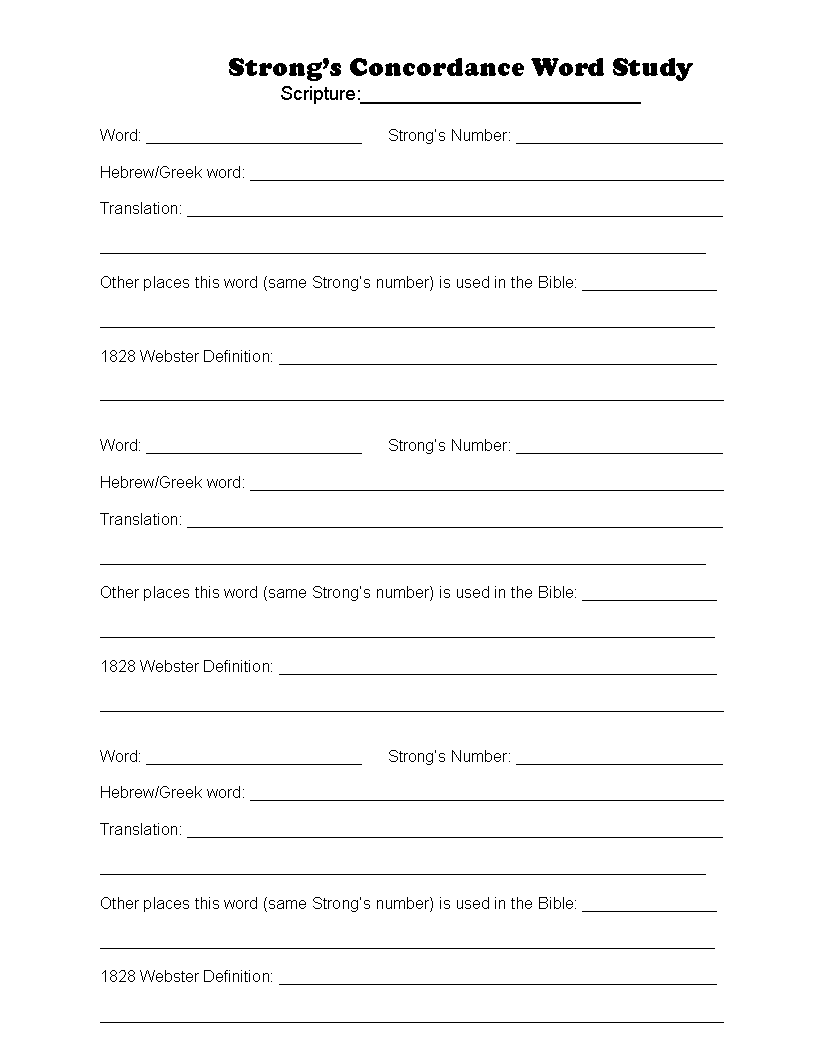
Here is a worksheet to help you get started


LESSON 10.0 Worksheet

What translation of the Bible do you need to use with the Strong’s Concordance?

Are there other reliable concordances available?

Why should we use the 1828 Webster’s Dictionary when studying with the Strong’s Concordance and King James Version of the Bible?

HOMEWORK

If you have e-sword or a Strong’s Concordance and King James Version Bible, look up one of your favorite verses and see if your understanding of that verse changes or stays the same after searching the words in it.

Look up the word “loved” from John 3:16.  What is the Greek word used? 

Is that your understanding of how God loved the world?

Wednesday, March 27, 2013

Basic Bible Study - Part 9


Previous lessons

Lesson 9.0 Topical Bible Study

Here is where I am going to veer off my original plan and switch lessons 9 and 10 around.  We will learn about topical Bible study today and next week about basic word studies.  Word study is one of the more complicated subjects, but topical studies can be a stepping stone into word studies.

Most Bibles have a concordance of their own.  We will use the larger Strong’s Concordance next week, but this week we will be using the concordance that we carry with us in our own Bibles.  If you look at the back of your Bible, you might find a concordance.  It often is limited in its content.  There are several advantages to this type of concordance.  First of all, it is attached to your Bible, so you don’t need a table full of books to use it.  I like to use mine in bed as I read at night.  Second, it has the same wording that your Bible has so you don’t have to find make sure your Bible and Concordance match translations.  Third, if it is the Bible you are use to using, you can become familiar with it quickly.  Finally, it is concise so you don’t have to wade through a bunch of entries to find what you’re looking for.

On the flip side while the back of your Bible’s concordance is concise, you may not find the verse you’re looking for.  The Hebrew or Greek word or definition is not often available in these concordances.
A concordance is not a dictionary, but more like the key is to a map.  Not every word in a Bible will be in a concordance.  For instance“articles” are not in there, so you won’t find every – and, the, a.  Looking at the verse, John 3:16, “For God so loved the world that he gave his only begotten son that whosoever believeth in Him should not perish but have everlasting life.”  You would likely find the words, “God, loved, world, gave, begotten, son, whosoever, believeth, him, perish, everlasting, life.”  These would be key words to look for in the concordance.  

Why is do we need these?  One reason could be to find the verse.  If you remember the verse but not the reference, you can use one of those words to find where it is located in the Bible.  I would liken it to an internet search engine.  If I wanted to find out how to make chocolate milk, I could find it with the word “chocolate”or “milk.”  In the concordance, rather than giving me website options, I get scripture options.  If I look up “world,” in the back of one Bible, I get 14 different options including John 3:16, John 7:7 and Titus 2:12, but before each scripture reference, is a phrase from the verse it represents.  “God so loved the w…” is the phrase before John 3:16.  I can then turn to that scripture and see if it is what I was looking for.  Another entry says, “Don’t copy… this w…”Rom 12:2.  The “w” represents the word I looked up “world.”  That particular Bible gave a definition to the word as well.  Not every Bible Concordance will do that.

Here is an sample of the concordance entry from the NIV Study Bible for the word, "world."
Sometimes during a sermon, the pastor or teacher will share a thought or verse or something that triggers a verse in my head that may pertain.  I might flip to my concordance and look up a key word from that verse so I can find it while he/she’s preaching/teaching.  If I can find it, I add it to my notes.  When I go back over my notes from the sermon or teaching, I have the beginnings of a new personal Bible study.  I can go to footnotes or cross-references and get a bigger picture of what God is saying about that message.

The lesson today is about topical Bible study and it took me a bit to get there, but that you have a bigger understanding of the concordance use, we can discuss how it can be a valuable tool in topical study.  My kids and I did a month of lessons on “Trust.”  That is a big topic, so the curriculum writer has narrowed the areas down so at one point we learned about sheep.  Sheep trust their shepherd.  The Bible refers to sheep a lot and Jesus refers to us a sheep and God being the shepherd.  I want to know more about this.  While the people of Jesus' time and area of the world could relate to sheep, I cannot fully grasp the inferences.  I've worn wool and seen sheep in real life,but know nothing about their habits, so I did a topical study on them.   I went to my concordance for a good starting place.  I looked up, "sheep," and I looked up, "Shepherd."  Once I found a few verses about them, there was another word that was commonly used, "Flock."  It became another word I looked up.  Other words that were used in my search were: Sheepfold, wool, lamb and staff.  You can make a topical study quick or as lengthy as you want.  It's your study and either way you will learn.

I can also look up things like anger or sadness or joy or fishing.  If the Lord lays a word on your heart, check it out in The Word.  My language may not make sense to you, but if there is a word you hear in conversation or one just pops in your mind, especially in prayer, it may be something to look up.  I had the word “ubiquitous” randomly pop into my head.  I didn't even know what it meant.  The first place I went was not the concordance, it was a dictionary and since I like electronic devices, I actually used dictionary.com on my phone.  Instant gratification… it means the same as omnipresent.  Everywhere.  At that point, I found another search I could do in the Bible. It didn't take long… neither word is in the Bible according to the few translations I used.  Though I heard the word omnipresent as I was growing up in Sunday School, it was strange for me to find that it was not actually in the Bible.  The Bible does describe in several places, however, that God is everywhere.

There are a few other books that are useful for topical studies.  Some are devotional books and some are encouraging mini books.  There are topical Bibles as well.  There are many emails going around with multiple scriptures on a subject too.  A way to make these things into a study can be to look up the verse about a topic and then go back and look at the verses surrounding it as we've done before to get the context.  Then you can go to footnotes and cross-references and ... you get the idea.

One book that I have that is topical was given to me as I graduated from High School.  It is called, "God's Promises for the Graduate," published by Thomas Nelson Publishers.  There are headings in the table of contents that lead to pages of scriptures related to that topic.  One such topic in that book, for example, is "For in Times of Anger."  There are 21 scriptures that are quoted in that section.  One of them is Ephesians 4:31-32 NKJV "Let all bitterness, wrath, anger, clamor and evil speaking be put away from you, with all malice.  And be kind to one another, tenderhearted, forgiving one another, just as God in Christ also forgave you."  If I need to know more of what the Bible says about anger (likely I do) I can look up all of those scriptures in context and make a great study out of them.

LESSON 9.0 Worksheet

When would you use the concordance in your Bible?

Do concordances in the back of most Bibles give every scripture reference for each entry?

Does every back of Bible concordance also include definitions for the words?

Are dictionaries useful for topical studies?

Homework:
Is there a topic that is dear to you that you've been curious about?  Don’t wait for Joel Osteen or some great preacher/teacher to write a book about it.  Look up the key word(s) and search out the Word of God concerning that topic over the next few weeks.


Wednesday, March 20, 2013

Basic Bible Study - Part 8


Previous Lessons

LESSON 8.0 Application of the Word.  
It is amazing to me to see how something recorded so many years ago can still apply to me today.  Some scriptures are plain: Acts 2:38 “Repent and be baptized…” while others  may be a little confusing.  Mark 10:21 “Go and sell everything you have ...”   There is more to each of these phrases and that is when we need to focus on learning to apply the word.  Often times, when you do a devotional or even look on Facebook, there is a scripture just pulled out.  One stand alone verse.  While this is appropriate in its intent, if you want to know the full meaning of each verse, you need to go deeper.

Let’s start with one verse and see how we can put application to it.
I John 1:9 NIV  “If we confess our sins, He is faithful and just and will forgive us our sins and to purify us from all unrighteousness.”
This verse can definitely stand alone or be used with other scriptures especially when beginning or leading someone into a relationship with Christ.  Let’s take a closer look and apply it.  Let’s read it in context.  That means read what comes before it and what comes after it.  Open your Bible to I John 1:9.  What is a good place to start?  What is a good place to end?  Letting the Bible interpret itself is a wonderful way to study it.  Some may look at our Bible's subheadings as my NIV Life Application Bible shows a subheading just before  I John 1:5 that says, "Walking in the Light."  Others may wish to go to the beginning of the chapter.  If you don't understand a verse by reading the verse or two before it, go back further.  This may mean to go to the beginning of a book or a chapter.  My life Application Bible continues a section from I John 1:5 to I John 2:14.  This may all be necessary to read to understand the true intent of that single verse.

Let’s look at a few other places in the Bible and use 2 different application worksheets.  The first one is called “Application Worksheet.”  This and the other worksheets in this lesson are adapted from “Inductive Bible Study Handbook from Leadership Resources International.  I have looked into trying to order more of this book, but it has no ISBN and I can’t find them online.  The front cover said to photocopy and put to use. While I do not understand if there would be a copyright infringement by using those sheets on a blog, I have recreated them and really they do look a lot different, the ideas are just the same.  This first one is not intended to be completely filled out because not every passage covers everything on this worksheet.

Look at Matthew 6: 19-34 and use it with this sheet.  This passage is loaded so we can fill out several sections of the worksheet.  You also may have more than one answer for each question.  Is there a lesson to learn? Where your treasure is, there your heart will be also.  Is there a prayer to pray?  I don't see a specific prayer to pray her, but if I look at Matthew 6:9-13, I would find a whole prayer.  Is there a sin to confess?  This is personal.  If there is an instruction in this passage that I struggle with as sin, I would likely write it here.  Is there a promise to claim?  Seek first his kingdom and his righteousness, and all these things will be given to you as well.  Is there a message to share?  There are several messages in this text.  This is a place where you need to have the guidance of the Holy Spirit.  Some of these messages need to be shared, but if you do so in your own power, you could turn people away.  If I go to my wealthy Christian friend and say, "You can't serve both God and money!"  I don't think it would be well received.  That is likely me judging my friend saying that they worship their money.  Is there an instruction to obey?  This is similar to the first question.  Do not worry about your life.  (One of several answers that can go here)  Is there a conflict to avoid?  Again, this is a personal application so if you struggle with money, maybe that is a conflict you need to avoid.  Is there an example to follow?  One could say that we should follow the example of the sparrow and don't worry about what you will eat.   Is there a new understanding to embrace?  There could be if you've never really noticed any of these teachings before.  Is there an attribute of God to marvel?  My heavenly Father knows my needs.  Each person who fills out this sheet will fill it out differently from others.  You really don't even need this sheet, you can just keep these thoughts in mind as you read new scripture.  You can answer some of these questions in your journal as well.

The next worksheet we will look at is a character worksheet.  It is possibly a little more thought provoking .  Here is one reason that this type of worksheet would be good.  If you’ve ever been told something like, “You have the heart of David.” or, "You have an Esther anointing."  It is important to review the Word and find out exactly what David or Esther did.  David is spoken of over a long portion of the Bible and though Esther is a small book, we’ll use something that is fresh in our memory from a recent study.
Let’s look at the Character Jonah.  Last week we looked at the book about him, this week, let’s look at some character things.  We will find out about him in his book, Jonah.


Jonah is mentioned in the Bible in the Old Testament book of Jonah.  He is also mentioned in Matthew 12:37,39,40,41; Matthwe 16:4,17; Luke 11:28,30,32 and II Kings 14:25.  I found this by doing a search on my digital Bible e-Sword.  When I searched on YouVersion, it misinterpreted my search and looked for John as well.

Always remember that when we use a new method of study or a new worksheet that we still have all of the other things we’ve talked about to go back to as well: footnotes, commentaries, cross-references, 5 W’s and patterns.

Here are 2 other possible worksheets to use.  They will be used in the homework section.


Lesson 8.0

Each new lesson adds to the previous.  Now that we are learning to apply the Bible, we can use the previous lessons to help.  Name 2 of these things:

In your own words, describe why it would be valuable to you to study a certain character of the Bible.  This answer doesn’t have to be the one given in class.

Homework

Use “Personal Application Worksheet” to look at Matthew 6:19-34 again.  Use “Parable Study Worksheet” to look at the Parable of the Good Samaritan from Luke 10:30-37.

Wednesday, February 27, 2013

Basic Bible Study - Part 7

Previous Lessons
Part 1  Part 2  Part 3  Part 4  Part 5  Part 6

Lesson 7.0
We’ve talked a lot about the Bible and how it is laid out.  We’ve gone through types and translations and digital Bibles.  We’ve talked about some observations and highlighting last week.  Now after 6 weeks, we finally get to start digging a little deeper into the Word of God.  Over the next 4 plus weeks, we are going to learn a few methods for studying the Bible.  Some of these will be with pre-made worksheets.  It obviously will not take a worksheet to do any of these methods, but as we learn them the worksheets will be a guide.  There is no need to become frustrated if you don’t do well with the method we discuss each week.  There are many more ways to study God’s Word and we will find one that works for you.

If you’ve discovered a method that looks neat, but you struggle with it, share it with me and I’ll try and figure it out and we can go through it as a class.  One thing about questions is that often times you are not the only one with that question, but maybe are just the first one with the courage to ask it.  You’re welcome to ask questions at any point or even say that you don’t agree or like something that we do.

Tonight we are going to discuss the 5 W’s.  Through school, we’ve been encouraged to look at them when reading for comprehension and when writing.  The 5 W’s are WHO, WHAT, WHEN, WHERE and WHY.  We can also add a HOW to that list if we want to.  If we apply it to the scripture, it is a great resource as well.  One of the things that may be a trip-up, though is that you may not be able to find the answer to a few of these questions.  For me a finished worksheet with blanks is daunting, but it is okay not to have all of the answers.
This is one way of doing the 5 W's worksheet.  This has been designed by me with no references.  Feel free to copy and paste it, adapt it to fit your needs, but please do not sell it.

This is another way of doing the 5 W's worksheet.  This has been designed by me with no references.  Feel free to copy and paste it, adapt it to fit your needs, but please do not sell it.

Often times the text itself will give us all of the information we need to understand the 5W’s.  Sometimes it is not there, but the introduction to a book will give us assistance.  Do note that not all Bible publishers agree on this information and so since we weren’t there at the time it was written, we just need to trust God for His direction.  A good thing to do before studying the Bible is to pray over it.  We need not bank our relationship with God and the study of His Word on humanity.  God sent us His Holy Spirit to help guide us in these things.

Why would we not be able to find out the information on this sheet?

First of all is the WHO.  Not every author of Bible books is known, so if a scholar with a life-long career in Bible research doesn’t know an author, we should not feel upset if we don’t find that answer.  The who can also be characters in a story or people groups.  Sometimes it is implied and sometimes it is a cultural implication.  We as Americans will not understand the intent.

Next is WHAT.  More often than not we will find a “what” in the scripture.  The what can be a situation or an object or structure or idea.  If it is not obvious right away, we don’t have to fret and we can come back to it.

WHEN.  When is very often difficult to determine.  Sometimes the best answer we can get is daytime or springtime.  Sometimes it is a specific time like the 12th day of the month of Adar.  There are calendars and helps that can assist us in figuring out the season and comparable date on the Gregorian calendar. 

WHERE.  The where can be in bed or in a specific town or country.  In a boat can also be where.

WHY.  This section is often up to interpretation.  Sometimes the Word gives it plainly.  This is one that we can often get hung up on and many Christians actually debate them.

HOW.  Sometimes a scripture will say that the "how" is to believe … Believe on the Lord Jesus Christ and You will be saved. (not in quotes because it may not be exact)  So the answer to, “How can I be saved?” is to believe on the Lord Jesus Christ.”

We will go through some worksheets together looking at the Book of Jonah.

Here is an example of how a 5W's worksheet could look when it is filled out.  Everyone in the class had their sheets filled out differently.  No one way is right or wrong.

Lesson 7.0 worksheet

T/F  You should keep studying a scripture until all sections of the 5W’s page is filled out.

T/F  There can be more than one answer to any of the 5W’s

What is one place to look outside of the chapters and verses to find answers to the 5 W’s?

If you’ve been successful at journaling, try writing the 5 W’s out in your journal as you study a passage and document it there.

HOMEWORK

Finish looking at the book of Jonah and answer the 5 W’s for each chapter.  If we finish it in class, try the book of Jude.  It is only one chapter long, but some of the answers may be a little more difficult to find.

Wednesday, February 13, 2013

Basic Bible Study - Part 6

Previous Posts
Part 1  Part 2  Part 3  Part 4  Part 5


Lesson 6.0  Highlighting and noticing patterns.

We will cover 2 topics this week.  We will first discuss highlighting in our Bibles and then patterns.  The first thing that comes to mind when thinking of highlights in the Bible is a line from The Incredibles movie.  “… once we’re all super, no one will be.”  This was said by Syndrome the villain when he wanted to destroy all the super heroes in the world and then sell people gadgets to give them pseudo-super powers.  This, for me, is true of highlighting in the Bible as well.  If every word of every page is highlighted, then nothing stands out anymore. 

I can’t say that there is no wrong way to highlight after that last little example, but different people will feel that a different portion of scripture is in need of a second look and that is what they will highlight.  I’ve been in services where the minister tells the congregation to underline something or highlight something.  It isn’t wrong for him to say that, but not everyone likes to write in their Bible.  Often I’ve already got that part highlighted.

There have been times where I can think of a scripture but can’t remember where it is in the Bible.  The things I remember are that it was on the bottom of a page near the end of the Bible and it was on the right-hand page.  Because I had it highlighted, I found it again.  I’ve also been in  a circumstance and flipped open my Bible and found a highlighted spot that was a perfect encouragement that I needed in that moment.

I’ve known of people who will read through the Bible in a year and use a yellow highlighter as they read.  The next year, they highlight in green and so on so that they can have a color journal of what spoke to them the most each year.  I think that’s awesome, but I don’t always stick to a plan that long.  I had planned to only highlight the scriptures that speak of love in pink and then Christian life in green and different colors for different categories of scripture.  Anything that I couldn't categorize, I highlighted yellow if I liked it a lot.  Develop your plan for colors.  If you can stick with it, it may enhance future reading.

I have highlighters especially made for Bible pages because they’re so thin.  I also have regular highlighters.  It really is not going to make or break you on what type you buy.  I even underline sometimes with my regular pen, but I need a ruler or a bookmark to get the lines straight.  Colors are a personal preference.

Let’s practice this skill and see what we all think is important.  It will be interesting to learn.  PLEASE do not be ashamed if you don’t feel like any piece of the passage should be highlighted.  The goal of this drill is to see the variations of different methods of highlighting.  This will not make you a better scholar or a worse one.

Patterns

Some of you may have noticed a pattern in this scripture passage and that is what you chose to highlight.  There have been times when the Lord repeatedly said, “IF  you will… THEN I will…”  I call this a pattern.  In Numbers 29 there is a definite pattern set forth under the feast of tabernacles.  I’ve learned that when God says something more than once, it is time to take notice.

When studying the Bible it is good to notice patterns.  There is several ways that we can notate a pattern as well.  One thing is to highlight the repeated word or words.  This will stand out to us the next time we open the Bible to that particular passage.  We can journal what we’ve noticed as a pattern.  When we journal things, we may have journalled it before and then flip back those few pages and recall what the Lord was speaking to us in the first incident where that something was mentioned.  It is okay to just read the Bible and enjoy it, but when we start noticing these patterns and things that God speaks through the Word, it becomes alive in us.

Another way to document a pattern is to write a symbol by that particular scripture.  I’ve written a cross by scripture in the Old Testament that refers to Christ.  I’ve put a heart by things that mention His love.  If you can draw a small shape, you can do these methods.  An asterisk can set apart a few verses as well.  We started learning to notice patterns in preschool and now we can apply that to the study of the Word of God.

You’re likely finding out that anything that you used in school to help you with your studies can be used in studying the Bible.  Write in the margins of your Bible.  Put a date when you studied that passage in the past... that date can be significant later in life.  When I studied in college for classes, I underlined or highlighted the things that I thought I would need to know for a test.  I wrote notes in the margin from lectures.  That is not different from Life.  The Bible is our guide to life.  It might just do us some good to have some things marked or highlighted that will help us on our journey through life.

Worksheet Lesson 6.0

What guideline will you use when highlighting in your Bible?

Have you ever been hesitant to make marks in your Bible?              Why or why not?

Has your view of highlighting changed or stayed the same since this lesson?

Homework

Read Psalm 119 this week.  Notice the pattern in this scripture.  There is a theme throughout this chapter and it revolves around a group of words with similar meaning.  Feel free to highlight favorite verses or mark repeated words.

Basic Bible Study - Part 5


Previous Lessons:
Part 1  Part 2  Part 3  Part 4

Lesson 5.0

Writing in a journal is not required to be a Christian, but it really can enhance the study of the Bible.  Not only can it help in Bible Study, but it can be a reminder of what you’ve journeyed through in your Christian walk.  Better than that, it can help you remember what God has done for you.

You can write your thoughts.  You can write a scripture that inspires you.  You can write a “Sermon” or teaching that the Lord lays on your heart.  You can take notes from what you hear in church in your journal.

A journal is not necessarily a fancy book, although it certainly can be.  Some journals are just a notebook that never gets the pages torn out.  Sometimes having a nice looking book can help encourage you to journal.  Fancy or plain, a record of what you’ve studied or thought or experienced is sometimes more valuable than money to you in the future.  It could carry you through a rough time in your life.

Sometimes a dream that God gave you is very important to write down.  If you have a peculiar dream, it is important to write it down as soon as you get a chance.  If you later realize it is from God, the details will be important as you find its interpretation.  The fact that Pharoah dreamed of fat and skinny cows really made a big difference when it came to interpretation.  Cows just eating cows could mean that there is just cannibalism in the land.

Sometimes, if you learned what a word means, you might write down every verse you find with that word in it.  It can enhance the things you already know and it gives you a bigger picture of God.  Also, you can draw pictures or doodles in a journal.  You can do a combination of words and pictures.  You can write song lyrics in your journal that have meant a lot to you.  Clip articles from newspapers or magazines and paste them in your journal.  Possibilities are vast.

In today's world, keeping a digital journal may be easier for some people.  It is certainly more compact.  One can journal using any word processor and save it to his or her device or computer.  This can be private or print and share experiences.  Some people journal on social networking sites as notes.  If you tweet, all that you tweet is public and you can reflect on your life from various status updates and tweets.  Some people blog as a journal and others do photo journals.  What ever form of digital journal you choose, first decide if it is public or private, then look at the possibilities of where to journal.  I have actually used the voice recorder on my phone to capture thoughts or even songs that I have written so that I can go back and find them again.  This is private, but can be considered a journal.

Jeremiah 30:1 CEV
1  The LORD God of Israel said, "Jeremiah, get a scroll and write down everything I have told you."

Worksheet Lesson 5.0

T/F  Writing in a journal is every Christian’s duty.
T/F  Writing in a journal may enhance your Bible study time.
T/F  There is no wrong way to journal.
T/F  Digital journaling is always public.

Homework
Purchase a notebook or journal or revive an old one this week and write in it with your Bible reading 3 times this week.  Do not limit yourself.  If you find that you enjoy journaling, do it daily.  Look into some preprinted journals if you prefer to journal that way.

Wednesday, January 30, 2013

Basic Bible Study - Part 4


Previous Lessons:


Two main digital Bible sources will be used for this study.  The first is e-sword, a downloadable Bible that is free to users, but some versions of the Bible and commentaries cost money as they are copyrighted.  The next is YouVersion which is a free online Bible with many versions to choose from.  It is available from any web browser, but also as an app for apple, blackberry, android and other smartphones and devices including the Kindle Fire.  To read many translations from YouVersion, you must be connected to the internet.  Some versions are available for download.  There are also other Bibles to download to kindles or electronic devices as well as Bibles that are a device in themselves.  The variety is vast, but with the covering of two types, hopefully the others will be understandable as well.
The first type of digital Bible study, e-sword is a downloadable Bible.  You only have to be connected to the internet for downloading the program.  When you use it, you will not need to connect to the internet.  You can find it at www.e-sword.net .  Once you go to that page, you will find a “button” on the right side that says, “Download e-sword now.”  

If you scroll to the bottom of the next page there will be 2 options.  If you’ve never downloaded the program before, you need to do the first option which is e-Sword v10.1.0 application installation .  
Click the down arrow button and follow steps from there.  If you feel more comfortable, you can have someone else walk you through those steps.  The benefit of this is that the Bible is stored on your computer and not the web.  There is less chance of a tampered with version of the Bible that way.
The highlights are added by the user.  The actual program has clearer print than this image.  It is a screenshot provided by the website.

The ease or difficulty of using e-sword will depend on how comfortable the user is with using the computer.  The books of the Bible are listed on the right.  You may download as many translations/versions of the Bible as you desire, but know that several of them cost money and it is an online transaction.  Those decisions are a personal choice, but there are many features that are beneficial and free.  We will walk through it as a class.  If you are only reading the blog, you are welcome to download this free version of the Bible.  If you so desire to help the developers of this excellent resource, there is a place to donate on their page.
Unfortunately I do not own a mac computer and cannot show how to get to the program using one.  I'm sure fluent mac users will have no difficulty finding the program on their computers.

The next digital Bible is an application and not a download.  The information is stored on the internet and a connection to the internet is necessary to read the Bible through it.  There are some downloadable versions of the Bible that can be stored to your device, but switching versions requires an internet connections when the Bible is in use.  The website is www.youversion.com .  If you create an account online, you can link your account to an app that you install on your smartphone, iPad, iPod, kindle, tablet or other electronic device.  When you go to the app store of your device, this Bible can easily be found by doing a search for, "YouVersion."   It is difficult to talk about what to do with these apps, so the rest of the class will be dedicated to using them.  If you are not in class, the best way to find out how to use the app is to just experiment.  Following this paragraph, I have included a tutorial on the use of YouTube.  It is just over 9 minutes long, so you can be prepared with your time if you are interested in watching this.  He uses an iPad, but other devices have similar use.  There are more videos with instruction on their use on YouTube and maybe even GodTube.


Worksheet Lesson 4.0

1. True/False  There are only 2 trustworthy digital Bibles

2. True/False  You don’t need an internet connection for e-sword after its installation is complete.

3. List any other digital Bibles that you’ve heard of or actually used.


Assignment:

Check out the digital Bibles that we’ve talked about this week and see if either of them are right for you.  If you don’t like it, there is nothing wrong with that, just keep reading your print Bible and you will be on a great path.  If you use a digital Bible that requires a password and user name, keep those in a safe place.  There is nothing wrong with opening a few accounts if you forget your user name or password, but many programs will only allow an email address to be used one time.

Find Mark 10:45 on a digital Bible